The dining room often contains some of the most substantial furniture in a home. A solid wood table, tall cabinet, upholstered chairs, and decorative pieces can quickly turn a seemingly straightforward relocation into a careful handling project. Their dimensions, weight, finishes, and fragile components all require different preparation.
For homeowners arranging a move in Las Vegas, choosing the right type of assistance can make the process much easier. Nevada Movers provides residential moving support, with more information available at https://nevadamoverslv.com/.
Begin by Separating What Needs Special Attention
Walk through the dining room several days before moving day and identify furniture according to its size and fragility. A heavy table should not be prepared in exactly the same way as a glass-front cabinet or a set of lightweight chairs.
Make a simple inventory of:
- Dining tables and extension leaves
- Chairs and benches
- Buffets and sideboards
- China cabinets or display units
- Mirrors and wall decorations
- Lamps and decorative accessories
This assessment helps determine what can be disassembled, what needs individual wrapping, and what may require additional care during carrying.
Preparing a Large Dining Table
The table is usually the centerpiece of the room and one of the hardest items to maneuver. If the legs are removable, take them off before transportation. For tables with extension mechanisms, remove loose leaves and keep their hardware together.
Protect the tabletop according to its material. Finished wood can be vulnerable to scratches, while glass requires protection against impact and pressure. Corners should receive extra padding because they can easily catch against door frames.
Do not place loose hardware inside a general box. A clearly labeled bag kept with the table components makes reassembly considerably easier.
Protecting Chairs Without Creating More Work
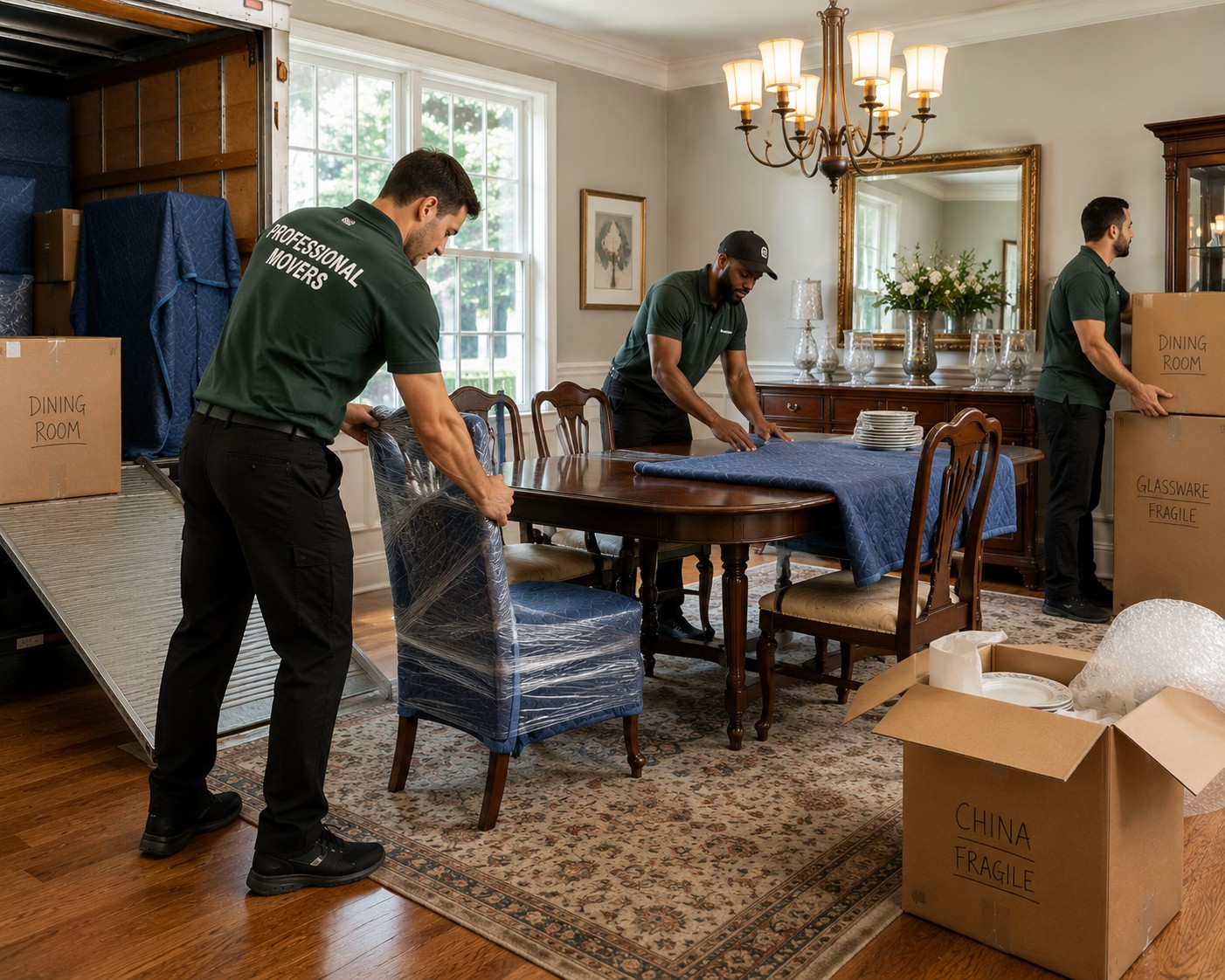
Dining chairs may seem less complicated, but their legs, arms, backs, and upholstery can create several potential problems. Wrap chairs individually when practical and place protective material between pieces that could rub against one another.
If several chairs have identical construction, label them as a set. This is particularly useful when a dining room contains matching chairs alongside benches or accent seating.
Upholstered furniture should also be protected from dirt and contact with rough surfaces during the move. Nevada Movers can provide the labor needed to handle and reposition residential furniture while it is being moved between locations.
Empty Cabinets Before They Leave the Room
A dining cabinet should never be moved while filled with dishes, glassware, or decorative objects. Remove everything from shelves and drawers first.
Glass shelves can be wrapped separately, while removable doors should be secured appropriately. Drawers should also be prevented from sliding open during handling.
Tall cabinets deserve particular attention because their height can make them difficult to turn through narrow corridors. Before moving one, check the route from the room to the exit and identify any tight corners or changes in elevation.
Don’t Forget the Small Pieces
Dining rooms frequently contain items that are easy to overlook during packing. Serving dishes, candleholders, artwork, mirrors, table decorations, and other accessories can become damaged when placed together without protection.
Wrap fragile objects individually and use appropriately sized boxes. Avoid leaving large empty spaces inside boxes because movement during transportation can cause objects to collide.
Labeling these containers by their intended location can also make unpacking faster once the furniture has been positioned in the new home.
Plan the Route Before Moving Furniture
One of the biggest advantages of preparing the route in advance is avoiding unnecessary maneuvering. Measure particularly large furniture and compare those dimensions with doorways, hallways, staircases, and elevators.
Remove obstacles from the path before carrying begins. Rugs, small tables, floor decorations, and other items can interfere with people carrying bulky furniture.
If the dining room is located far from the entrance, decide beforehand how the largest pieces will be turned and positioned. Good route planning can reduce both delays and accidental contact with walls or door frames.
Residential Moving Assistance for the Heavy Work
Some homeowners prefer to pack their smaller belongings themselves while bringing in professionals for the demanding furniture portion of the relocation. This approach can be useful when a dining room contains oversized pieces that are difficult for one or two people to maneuver safely.
Nevada Movers offers residential moving services for households that need professional help with their relocation. Details about this service can be found here: https://nevadamoverslv.com/services/residential-moving/.
Set Up the Dining Room With a Plan
Before the furniture arrives at the new property, decide where the largest pieces will be placed. Clear those areas and make sure there is enough room for movers to position tables, cabinets, and seating without repeatedly shifting them.
Once the furniture is in place, inspect the tabletop, cabinet surfaces, glass components, chair legs, and other vulnerable areas before removing all protective materials.
A dining-room move becomes much more manageable when furniture is treated according to its individual characteristics rather than handled as a single group. Careful preparation, a clear carrying route, and appropriate residential moving assistance can help preserve both the condition and appearance of the room throughout a Las Vegas relocation.