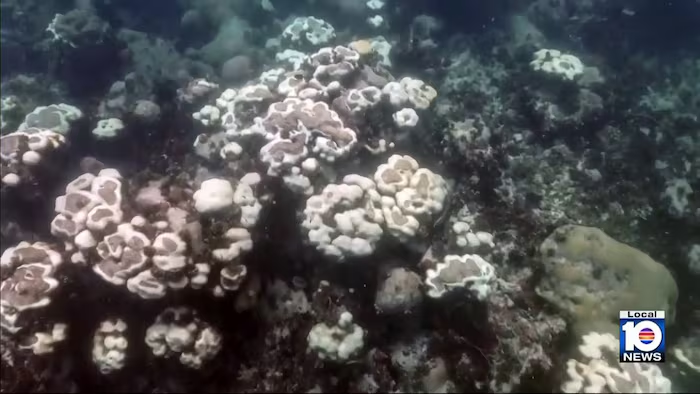
MIAMI-DADE COUNTY, Fla. — South Florida corals are in crisis again.
The National Oceanic and Atmospheric Administration (NOAA) is already sounding the alarm as ocean temperatures once again climb into the danger zone for widespread bleaching.
Read more TPS extended for Haitians until July 27, court rules
Ian Enochs leads the coral program at the NOAA lab in Miami.
Cheeca Rocks is an important climate monitoring site, famed for its historic resilience and now on the front lines of climate change.
“These corals can’t move,” said Enochs. “They’re in incredibly warm water and this is all happening right now. It’s an area that we know really well, that we’ve been monitoring really closely. Last week, we started to get some reports that there is some bleaching already happening now, this early on in July.”
This is not the first time this has happened. At the end of July 2023, the hottest July ever recorded on Earth, the worst mass bleaching event in Florida history was triggered.
“We’re seeing 100% bleaching,” said Enochs. “That’s crazy. It’s absolutely crazy.”
Now history appears to be repeating itself.
The Midwestern Regional Climate Center says South Florida has already endured 38 straight days of triple-digit heat indices, and ocean temperatures are rising again.
NOAA has already raised its coral bleaching alert for parts of the Florida Reef Tract.
“We start to go into higher levels of alert as the summer progresses, and what’s really concerning right now is we’re already hitting these alert levels this early on in July,” said Enochs.
Local 10 News’ Louis Aguirre got into the water for a close-up look, and the devastation was immediately apparent.
“It’s worse than I expected,” said Enochs. “The tops are turning white, and if they stay like that or get worse, they could die, and that would be really bad for the ecosystem for the persistence of this overall reef.”
These are some of the oldest and most resilient corals on the Florida Reef Tract, which are still recovering from the summer of 2023, and now this is happening again.
The outlook is alarming.
“These reefs have been hammered over and over again,” said Enochs. “This reef is one of the healthiest that we still have, and to see this level of stress, to see these corals responding in this way, is really disconcerting, especially this early on in the year.”
So far, it hasn’t quite spread, yet.
“It seems to be a little bit more localized to this reef,” said NOAA ALML Coral Program research associate Tyler Christian. “We looked at a few other transects last week, and they weren’t as bad. This one was the worst site that we surveyed, and it is worse now.”
The group then moved on to a patch reef just five miles north that was already showing signs of heat stress.
Read more European Union gives its greenlight to Paramount and Warner’s mega merger with some conditions
“Not as bad here as Cheeca Rocks, but you saw it as well, there are definitely signs of paling and bleaching here as well,” said Enochs.
Over the last 40 years, Florida’s Reef Tract has lost more than 90% of its healthy coral cover due to disease, pollution and repeated bleaching, driven by climate change.
Enochs fears we could be in for another repeat of 2023, if not worse.
“The amount of stress that the corals are experiencing at Cheeca Rocks is already higher than it was in 2023,” he said.
The hope is that by catching this bleaching early, scientists can identify which reefs are most at risk and, in some cases, step in before that damage becomes irreversible.
Phanor Montoya is the restoration program manager for the Coral Restoration Foundation (CRF), the world’s largest coral restoration organization, growing and outplanting corals to help rebuild Florida’s reefs.
“We don’t know (if it will be similar to 2023), but we are preparing for it,” said Montoya. “We’ve proven that restoration saves species. If it wasn’t because of restoration by CRF and others in Florida, we had already lost the staghorn and the elkhorn corals from Florida. Right now we have more corals in our nursery than we have on the reef.”
When the marine heat wave hit in 2023, CRF launched an emergency rescue, moving thousands of vulnerable corals from offshore nurseries into land-based facilities until conditions improved. But in some cases, it was too late; many of the already stressed-out corals would not survive.
“We started the summer with about 45,000 corals across all our nurseries,” said Montoya. “By October, we had lost 52% of our stock. Fifty-two percent was gone due to the summer. We ended up with 17,000 corals, 17,000 survivors across all our nurseries.”
Montoya doesn’t know what the rest of the summer will bring, but improvements have been made to infrastructure and response protocol should another marine heat wave hit.
Right now, none of CRF’s nurseries are showing any signs of bleaching, but regulatory permits have been requested to move vulnerable corals should conditions worsen.
“We have already asked permission from the regulators to move about 3,500 corals from our different nurseries to Elbow nurseries, seeking better conditions there,” said Montoya. “That’s happening, we’re just waiting for the green light to do it.”
Meantime, the University of Miami’s Rosenstiel School is already mobilizing, launching a coral reconnaissance and recovery mission to collect different colonies of threatened elkhorn coral.
The corals will be brought to land-based facilities, hoping to preserve their genetic diversity should the bleaching event intensify.
Read more House votes for Department of War renaming as part of an annual defense bill