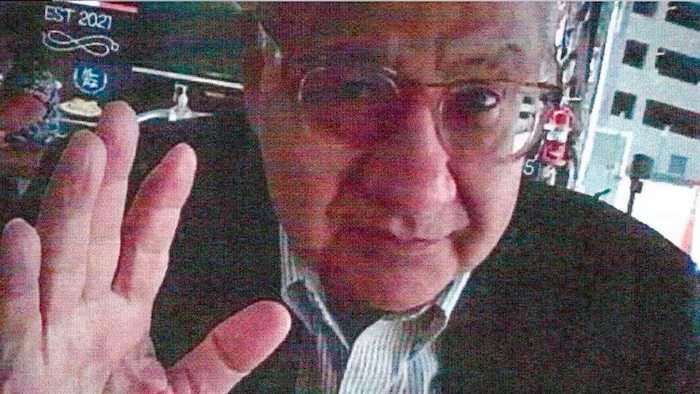
MIAMI — U.S. Attorney Jason A. Reding Quiñones described Victor Manuel Rocha on Friday as “one of the most prolific Cuban spies ever uncovered in the United States.”
Read more Broward legal community raises funds for homeless veterans
Leer en español
The Colombian-American New Yorker, who served in both the U.S. Department of State and Department of Defense, lived in Key Biscayne when FBI agents arrested him in 2023.
“I have created the legend of a right-wing person,” Rocha told an undercover agent pretending to work for Cuba’s Intelligence Directorate during a meeting on Nov. 16, 2022, in Brickell, records show.
Rocha, 75, who moved to the U.S. when he was 10 and became a U.S. citizen at 28, is serving 15 years in prison in central Florida. On Thursday, federal prosecutors moved to revoke his U.S. citizenship.
“The complaint alleges that Rocha obtained American citizenship through lies, concealment, and betrayal,” Reding Quiñones said in a statement about the new civil denaturalization complaint. “A person who secretly serves communist Cuba should not keep the privilege of United States citizenship, even while in prison.”
Federal Bureau of Prisons records on Friday showed Rocha was at a low-security correctional institution in Sumter County, and his release date wasn’t until March 29, 2036.
FBI Miami special agents profiled Rocha and zeroed in on him in 2022. He was born in Bogotá during the Liberal-Conservative warfare displacement in Colombia.
After his father died, Rocha moved to New York City when he was 10 years old and grew up in Harlem with Rosalba Leon, his single mother, who worked as a seamstress in sweatshops.
Rocha’s fate changed after the 1964 race riots in Harlem. He won a scholarship to the Taft School, a private boarding school in Connecticut, graduated cum laude in 1969, and earned his bachelor’s degree in Latin American studies from Yale in 1973.
“Rocha was attending a student program in Chile in 1973 when he was first approached by and started conspiring to spy for the Republic of Cuba,” prosecutors wrote in a 232-page civil denaturalization complaint filed on Thursday.
It was a year of change in Chile. Salvador Allende, the first democratically elected Marxist leader in Latin America, was overthrown by a military coup, and Gen. Augusto Pinochet took power.
“During my formative years in college, I was heavily influenced by the radical politics of the day,” Rocha told a federal judge in court on April 12, 2024, records show.
Rocha earned a master’s degree in public administration from Harvard University in 1976 and a master’s degree in international relations from Georgetown University in 1978 — “to advance his service as a secret agent of Cuba,” according to the complaint.
Rocha was a student at Georgetown when he applied for citizenship, and he was 28 when he took the oath of allegiance in Virginia to receive his certification of naturalization on Sept. 17, 1978, records show.
“Had Rocha been truthful during his naturalization proceedings regarding his affiliation with the Communist Party and actions as its secret agent, the former Immigration and Naturalization Service would not have recommended approval,” prosecutors wrote in the complaint.
Rocha joined the U.S. foreign service in 1981 after an internship at the Inter-American Foundation, a federal agency that funds projects in Latin America and the Caribbean.
Read more Gunfire damages several businesses at Margate shopping plaza
After diplomatic assignments in the Dominican Republic, Honduras, Mexico, Cuba, and Argentina, President Bill Clinton appointed him as U.S. Ambassador to Bolivia on June 14, 2000.
“My deep commitment at that time to radical social change in the region led me to the eventual betrayal of my oath of loyalty to the United States during my two decades in the State Department,” Rocha told a federal judge in court on April 12, 2024, records show.
Rocha left the State Department in 2002 and went on to become an advisor to the Commander of the United States Southern Command in Doral.
“Rocha would and did provide false and misleading information to the United States to obtain and maintain employment, and to acquire and maintain access to sensitive and classified information,” prosecutors wrote in the complaint.
An undercover agent contacted Rocha on Nov. 15, 2022, claiming to represent his “friends in Havana,” and there were three recorded meetings before questioning him on Dec. 1, 2023, records show.
During the recorded meetings, Rocha referred to the U.S. as the “enemy,” praised Fidel Castro as the “Comandante,” and his fellow communists as his “comrades,” according to court records.
“Unfortunately, she was betrayed … a huge betrayal … sadly she would have done much more had she not been betrayed,” Rocha told the undercover agent on Feb. 17, 2023, about Ana Belén Montes, a former senior analyst at the U.S. Defense Intelligence Agency, who was arrested for spying for Cuba in 2001, records show.
Rocha talked to the undercover agent about the 1996 killings of the Brothers to the Rescue volunteers Carlos Costa, Armando Alejandre, Jr., Mario de la Peña, and Pablo Morales, records show.
“I lived through it because I was in charge. It was the knockdown of the small planes. That was a time of a lot of tension. Brothers to the Rescue and other similar people who were pushing politics towards unnecessary provocations,” Rocha told an undercover agent on Nov. 16, 2022, records show.
Rocha also said that during his espionage, he had used a Dominican Republic passport to travel to Panama and then to Havana, records show.
“This is a huge sacrifice. Huge, with a lot of tension that you have to manage internally with self-discipline, all the time … When you have the conviction, you have self-discipline,” Rocha told the undercover agent about his “almost” four-decades of work as a spy, which included some with “Top Secret” access, records show.
Rocha also described his work for Cuba as “enormous” and “more than a grand slam,” records show.
Rocha pleaded guilty to conspiracy to act as an agent of a foreign government and defrauding the U.S. In the new case, federal prosecutors accused him of seven independent counts seeking the revocation of his U.S. citizenship.
“Any individual who lied during the naturalization process to gain a foothold in this country will be met with the full weight of the Department of Justice,” Assistant Attorney General Brett Shumate said in a statement released on Friday.
Read more Brush fire causes closure of U.S. 1 heading in, out of Florida Keys
Rocha’s career with the State Department
- International Relations officer (November 1981 to December 1982)
- Political officer at the U.S. Embassy in Santo Domingo, Dominican Republic (December 1982 to January 1985)
- Political-Military Affairs Officer at the U.S. Embassy in Tegucigalpa, Honduras (February 1987 to February 1989)
- First Secretary at the U.S. Embassy in Mexico City, Mexico (February 1989 to November 1991)
- Deputy chief of mission at the U.S. Embassy in Santo Domingo (November 1991 to July 1994)
- Director of Inter-American Affairs on the U.S. National Security Council (July 1994 to July 1995)
- Deputy Principal Officer at the U.S. Interests Section in Havana, Cuba (July 1995 to July 1997)
- Deputy Chief of Mission at the U.S. Embassy in Buenos Aires, Argentina (July 1997 to November 1999)
- U.S. Ambassador to Bolivia at the U.S. Embassy in La Paz, Bolivia (July 2000 to August 2002)